 OASIS FARMS
Overview
OASIS Farms combines practical aquaculture experience from the Pro Terra operation in Tamaya, Morocco, with a modular fish-production design for arid coastal regions. The aim is a repeatable production process, integrated with water management and biological nutrient recovery. The existing Tamaya operation is a reference and partner experience; the planned OASIS farm performance has not yet been demonstrated.
Breeding and hatchery
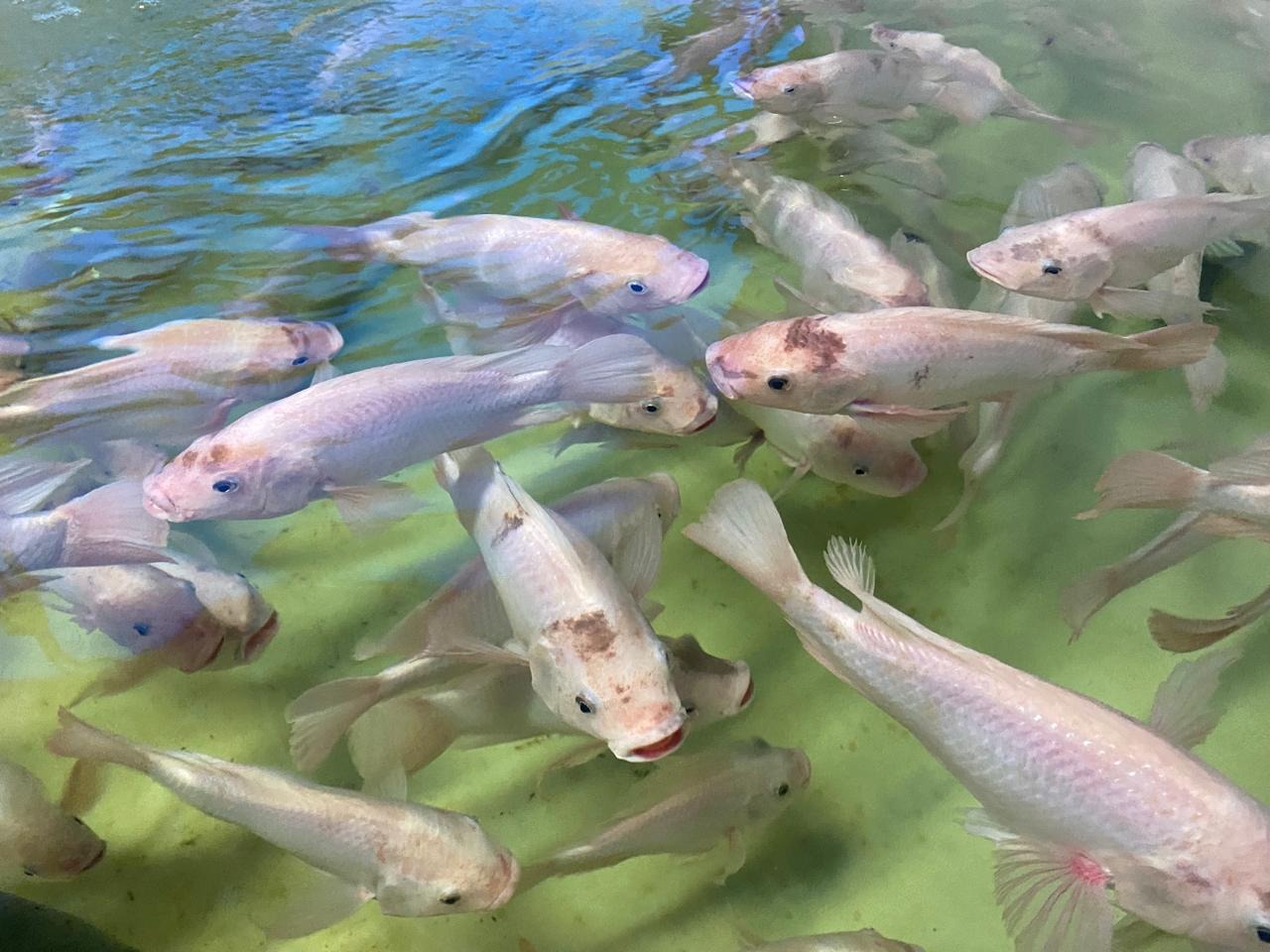
Each fish module is designed with a compact 6 m² breeding still, approximately 0.4–0.6 m deep, containing six females and two males. The planned output is 2,400 juvenile fish per month. Eggs are incubated using McDonald-type devices; newly hatched fry are kept in a small tank during month 0. Reproductive output and fry survival are design targets to be checked during the ODD.
Juvenile rearing
After approximately four weeks, juveniles move into IBC rearing tanks for a further eight weeks (months 1 and 2). Feeding, water quality, size grading and survival are monitored. Tank number and operating volume will be finalised against observed biomass and growth.
Saline-water adaptation
After the eight-week IBC nursery stage, juveniles are transferred around month 3 to the first 4 × 8 m (32 m²) earthen grow-out pond. Acclimation to saltwater takes approximately one week: water salinity is increased gradually each day until the intended operating salinity is reached. Fish behaviour, health, water quality and survival are closely monitored throughout the process. Daily salinity increments depend on the tilapia strain and will be verified during operation.
Grow-out system
The first grow-out still is 4 m wide and 100 m long. The current layout assigns 8 m to month 3, 8 m to month 4 and 16 m to month 5. The remaining 68 m of the first still and a second 400 m² still are flexibly subdivided for later growth stages, broadly months 6–8 and longer if necessary. Average water depth is about 1 m, reaching 2 m in the centre. Fish are graded by size and biomass rather than allocated rigidly by age in the final stages.
| Month 3 | 8 m × 4 m = 32 m² |
| Month 4 | 8 m × 4 m = 32 m² |
| Month 5 | 16 m × 4 m = 64 m² |
| Later stages | Flexible: 272 m² + 400 m² |
Water quality and feed
The system is designed around aeration, circulation, solids management and monitoring of dissolved oxygen, temperature, salinity, pH and nitrogen compounds. A biomass density of 20 kg/m³ is an initial engineering reference, not a validated optimum. Feed is initially based on appropriate aquaculture diets; partial substitution with locally produced ingredients is a separate development activity.
Production model
Each module targets 2,400 juveniles per month and 2,000 marketable fish per month at approximately 800 g. Six modules would therefore produce 12,000 marketable fish, or 9.6 tonnes, per month at steady state. At the current indicative reference price of €3.10/kg, gross fish sales would be €29,760/month per standard farm, before operating expenses. The time required to reach market weight and the commercial output remain to be established.
| Breeding fish / module | 6 female + 2 male |
| Juveniles / module / month | 2,400 |
| Marketable fish / module / month | 2,000 (target) |
| Fish / farm / month | 12,000 (target) |
| Fish biomass / farm / month | 9,600 kg (target) |
Operational verification
The Operational Due Diligence will measure growth under seasonal conditions, survival, feed conversion, stocking density, oxygen demand, energy consumption, salinity tolerance, fish health and actual costs per kilogram. Results will determine the final compartment sizes, harvest timing and replicable farm specifications. A separate experimental programme will describe trial designs and acceptance criteria.