 OASIS FARMS
Seawater is more than a source of water
OASIS Farms and Schaef Systemtechnik GmbH are developing a solar brine-mining process intended to concentrate seawater step by step and recover its dissolved minerals. The system combines evaporation and potential condensate recovery, salt crystallization, and the production of magnesium-rich raw materials. Its modular design allows a farm to focus on simple crude-salt harvesting, while higher-value processing may take place on site or through specialized partners. Actual value creation must be established through measurements, product analyses and offtake agreements.
Minerals as the primary product – water as an economic by-product
Conventional seawater desalination focuses on producing fresh water. It also generates concentrated brine, whose discharge into the sea can pose challenges, especially in sensitive coastal environments, and is subject to site-specific regulation.
Solar Brine Mining takes a different approach: instead of treating dissolved minerals as one waste stream, it aims to separate and recover calcium compounds, sodium chloride and magnesium-rich raw materials in successive process stages. This could substantially reduce the amount of brine requiring marine discharge and potentially eliminate it. Complete recovery of all residual streams has yet to be demonstrated.
Our economic thesis is that revenues from recovered minerals could exceed revenues from recovered water. If proven, water would become an economic by-product while mineral recovery could become the main value driver of desalination – potentially its “cash cow”.
This is a significant opportunity, not a demonstrated commercial result. Actual yields, purity, processing costs, sales prices and reliable buyers must be established. Condensate recovery has not yet been validated either. The ODD will test this thesis through complete water, mass and economic balances.
Three sections – one coordinated material flow
Inside the Brine Mining Still, the evaporation area is divided into three functional zones. Brine is pumped between them when the respective process conditions are reached.
1. Calcium section: pre-concentrating seawater
Ordinary seawater enters the largest section. Water evaporates while calcium-containing compounds are intended to be selectively precipitated. At a planned total salt concentration of 220 g/L, the brine is transferred to the NaCl section. The calcium precipitation method and its selectivity still require testing.
2. NaCl section: crystallizing salt
Further solar evaporation is intended to crystallize sodium chloride. Crude salt may accumulate in the crystallization basin over time before mechanical harvesting. After as much NaCl as practicable has precipitated, the remaining mother liquor is transferred to the magnesium section. Evaporation alone cannot remove all dissolved NaCl; the optimum transfer point must be established experimentally.
3. Magnesium section: raw material for downstream processing
The magnesium-rich residual brine is concentrated further. The objective is a recoverable salt slurry or solid for external processing. Both direct removal from the basin and a separate collection/dewatering pit will be assessed. Whether the raw material consists predominantly of Epsom salt (magnesium sulfate heptahydrate) requires analysis: seawater bittern may also contain magnesium chloride and other salts.
What we actually observed in Tamaya
In a single summer trial, approximately 400 liters of ordinary seawater were poured into a test area that was not perfectly level. Most of the previously wetted surface was dry by the first day; after about three days all the water had evaporated. The sand beneath the liner was already warm when the test began and may have accelerated the initial evaporation.
This observation demonstrates the principle of solar concentration. It does not establish a sustained performance of 4 L/m²/day: the wetted area decreased because the basin was uneven, and stored heat in the sand may have influenced the start. The quantity of condensate actually recovered was not measured.
During ODD, water level and replenishment, wetted area, brine concentration, temperatures in water and soil, weather data and condensate volume will be monitored separately over extended periods.
Objective: creating value from both water and minerals
Solar Brine Mining is not designed solely for freshwater production. Recovered water is an important potential benefit, but a larger share of the intended economic value may come from mineral recovery and sales. The principal targets are calcium compounds, sodium chloride (NaCl) and magnesium compounds. Rather than treating concentrated brine only as waste, the aim is to separate it into usable mineral fractions. Product types, purities, yields and economic feasibility will be investigated during Operational Due Diligence. Greater mineral value is a commercial hypothesis, not a proven result.
Solar Brine Mining as a complement to reverse osmosis
Reverse osmosis (RO) produces a concentrated saline stream alongside recovered water. RO projects require a site-specific, legally acceptable approach to managing this concentrate. Permitted discharge may be possible depending on the location and jurisdiction; full resource recovery is not universally required.
SST's Solar Brine Mining concept could accept RO concentrate, concentrate it further and potentially recover calcium, sodium chloride and magnesium fractions. It may offer an additional option where concentrate discharge is constrained.
Suitability depends on RO-concentrate chemistry, antiscalants and other additives, land requirements, mineral quality and remaining residual streams. Technical performance, a complete material balance and necessary permits remain to be demonstrated.
Existing prototype and engineering development
Schaef Systemtechnik GmbH has developed the Brine Mining Still technology to prototype stage. A prototype exists in Tamaya, Morocco. Engineering work includes tested concrete-profile samples, a proposed double-bottom condenser and a prototype programmable monitoring controller. Thermal characteristics and material behavior have also been examined on a collector still. Commercial validation of the integrated system remains outstanding.
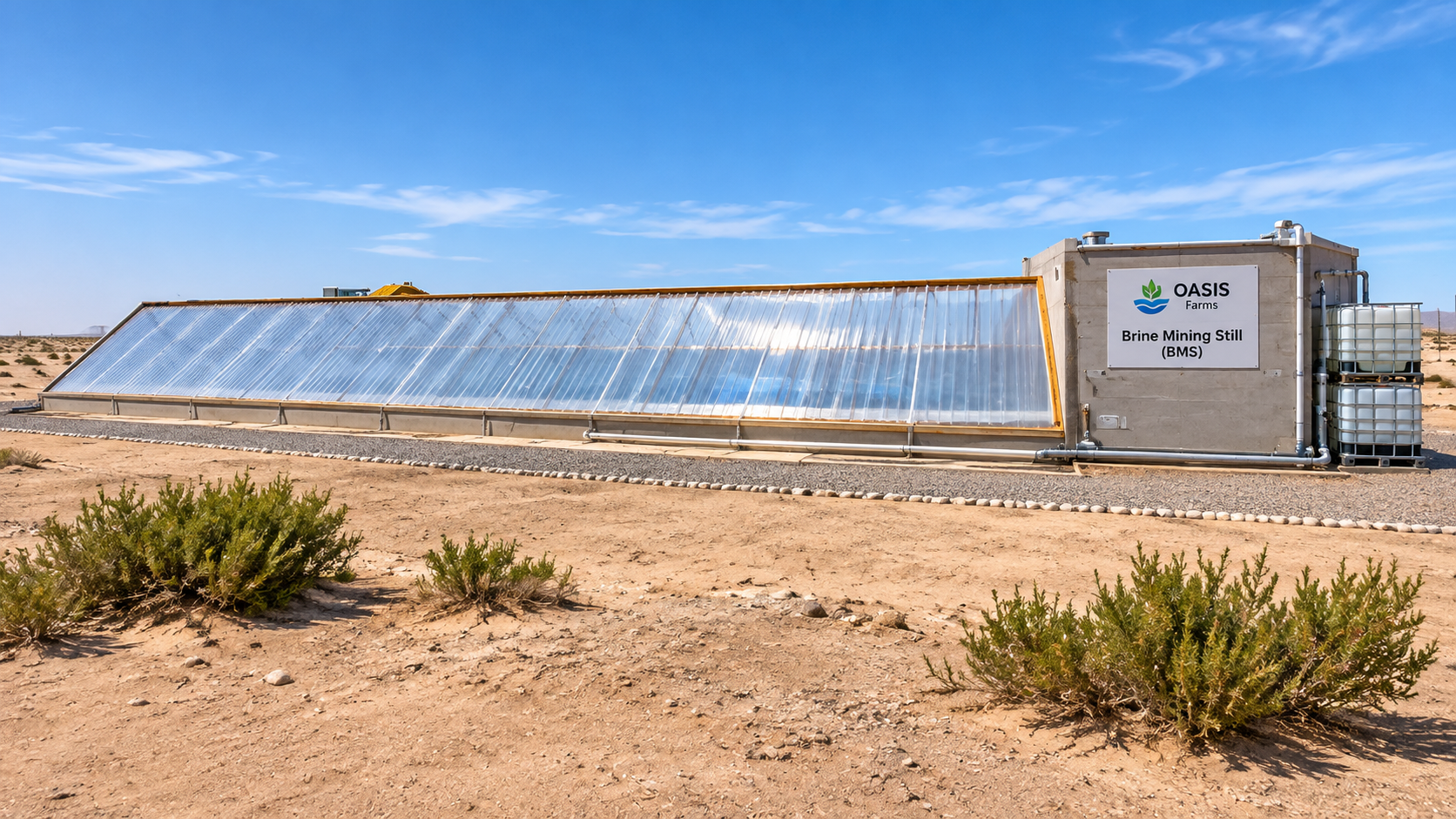
Solar evaporation and condensation
The Solar Brine Mining Still uses solar heat to evaporate seawater and concentrate the brine in stages. Additional condensation of water vapor is planned, but the achievable recovery rate has not yet been established. Condensate must not be described as drinking water without quality testing and, where necessary, treatment.
Heat recovery and process control
Recovering latent heat from condensation through a proposed double-bottom condenser is a development goal and has not yet been implemented in the Tamaya prototype. Preheated sand beneath the basin liner may temporarily release heat into the water. Whether this improves the long-term daily energy balance requires temperature measurements and energy accounting. A programmable controller is intended to log measurements and operating conditions.
Seawater intake, storage and distribution
Coastal beach wells are the preferred option for seawater intake. Seawater passes through natural sand and sediment layers before reaching the well. Compared with open intake, this can reduce suspended solids, sand and larger biological particles and therefore lower mechanical pretreatment requirements. More stable source-water quality and reduced direct exposure to waves, weather and tides are also anticipated. These benefits depend on local geology and hydrogeology and must be verified through site-specific yield, water-quality and tidal-impact studies.
At Tamaya in Morocco, beach-well seawater supply has reportedly operated reliably for years. SST prototypes there are supplied by the same existing system. This provides practical experience, but suitability and capacity must be assessed independently for every future OASIS site.
Pumps and storage tanks will feed separate distribution circuits. Seawater, recovered water and concentrated brine will remain segregated. Treatment, corrosion protection and redundancy will be specified for each location.
Preliminary design capacity and integration
A provisional standard-farm model considers approximately 10 hectares of Brine Mining Still area and around 400 m³ of seawater intake per day. At the proposed 70/25/5 area split, this corresponds to 7 ha of Ca, 2.5 ha of NaCl and 0.5 ha of Mg sections. These are planning assumptions: annual evaporation, condensate production and marketable mineral yields have not yet been validated by measurements.
Minerals: raw products without requiring an on-site refinery
The business model is deliberately flexible. A farm may harvest NaCl as simple crude salt; higher-value products, purification and recrystallization require additional processing and quality verification. The magnesium-rich fraction may initially be supplied to a specialist processor as salt slurry or solid.
| Fraction | Intended product | Evidence still needed |
|---|---|---|
| Calcium | Calcium-rich precipitate | Chemical form, yield, separation |
| NaCl | Crude salt, potentially refined salt | Purity, harvesting cost, market specifications |
| Magnesium | Salt slurry or solid | Mg/sulfate/chloride content, processability |
There are contacts with prospective buyers and processors, but no binding mineral offtake agreements or representative laboratory analyses are currently available. Accordingly, no assured product revenues or saleable volumes are claimed.
Reducing microplastics in recovered salt
A further development objective is to reduce microplastic contamination in recovered salt. The enclosed or protected process design may limit additional plastic particles introduced by wind and dust compared with conventional open salt pans. Lower microplastic levels have not yet been demonstrated by comparative analysis. Feed seawater, construction materials and operations remain possible sources. Representative salt samples will be assessed using suitable, comparable laboratory methods during ODD.
Operational Due Diligence: from prototype to reliable data
Solar Brine Mining is a supporting development workstream within OASIS ODD. The project's primary initial objective is to demonstrate the commercial viability of aquaculture. For brine mining, the following questions will be addressed quantitatively:
- Evaporation: seasonal rates at known wetted area and varying salinity.
- Water: actual condensate recovery, quality and energy requirements.
- Heat: temperature profiles in sand, water and condenser; potential benefits of planned heat recovery.
- Process: calcium precipitation, transfer at 220 g/L, NaCl crystallization and the optimal transition to the Mg section.
- Products: laboratory analysis, impurities, slurry versus solid extraction and downstream processing.
- Economics: materials and maintenance, harvesting costs, actual offtake terms and value per tonne of raw product.